
I had long be interested in stars, planets and our moon.
As a child I had made a telescope as described in my
Science Story. It involved long sessions in freezing cold while everything was aligned and pictures taken.

Times had moved on. I read about the SeeStar S50 which I bought for £549. They are cheaper now. It's only 250mm high, and weighs 3kg. It has no eyepiece, just a 3Megapixel camera. Your smartphone links to it and is your eyepiece. I can also stream it on to our big TV. It does have a computer, 64GB of storage, a 6Ah battery (6 hours use), wifi and bluetooth. It means that you can set it up outside, program some objects to see using your phone, and go to bed! The camera tracks the selected object across the night sky, collecting all the light photons falling on the lens over hours. It saves the image every 20s or so, for later analysis which lines up the desired object precisely by fixing on the neighbouring stars.
Setting it up is important. It needs to have a good view of plenty of the night sky. I made the high support shown on the left. It has level adjusting screws, and maintains an exact level for weeks if always replaced in the correct orientation. Putting on our concrete yard is fine too, but needs levelling each time. The best viewing is often high in the sky (where there is less atmosphere to pass through)
There follows a list of my best currect targets moving outwards in distance, so the moon, the planets, the sun, the nebulie and galaxies. The quickest pictures are from the moon. The "field of view" of the SeeStar is 0.7o by 1.3o. This nicely matches the moon and sun. The Andromeda Galaxy is a bit bigger than this, but clever software allows for this by scanning any defined area of the sky. Most objects of interest are much smaller than the field of view. The "mosaic" feature makes this not a problem.
Our moon: Distance 1.2 light seconds
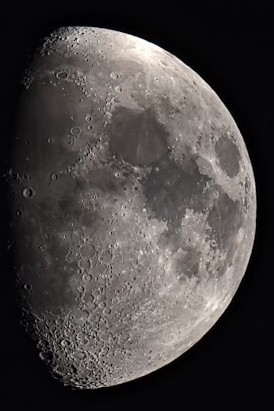
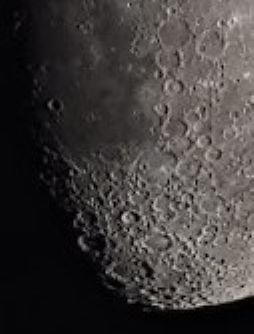
The moon is thought to have arisen from some giant impact of another body: it has an almost identical isotopic composition as the earth. It's radius is just 27.25% of the earth, but it's mass is only 1.23%, and it's gravity only 16.54%. It's mean distance from the earth is 384,784km or 1.2 light seconds. It spins in the same direction as the earth but at an angle of 5.14o. Famously it's orbital period is our month of 29.53 days.
On the left is a 2/3 full moon, taken when it was especially bright in December 2025. On the right is a blow up of the lower corner showing the detail, but revealing the resolution achieved.
Jupiter and it's moons: Distance 32.7 to 53.8 light minutes

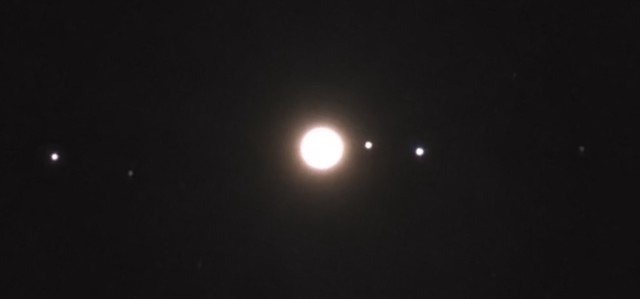
Jupiter is our largest planet. It's distance from us on earth varies as the go round the sun at different speeds between 32.7 to 53.8 light minutes. It's diameter is 10 times that of the earth, and it is mostly gas: 3/4 hydrogen and 1/4 helium suggesting that was formed at an early stage in the development of our solar system.
It's the second brightest planet after Venus, and is easily seen by the naked eye and was studied in the fourth century BC by the Chinese. It is not so easy to see with the SeeStar as it subtends only 0.01o from the earth. It's detail can be revealed by low contrast settings.
Galileo discoved the four largest moons with his newly-discovered telecope. Their obvious rotation around Jupiter was strongly suggesive to the Copernicus theory that everything did not go round the earth (although Galileo had to go before the inquisition for saying so).
The sun: Distance 8 light minutes 19 seconds
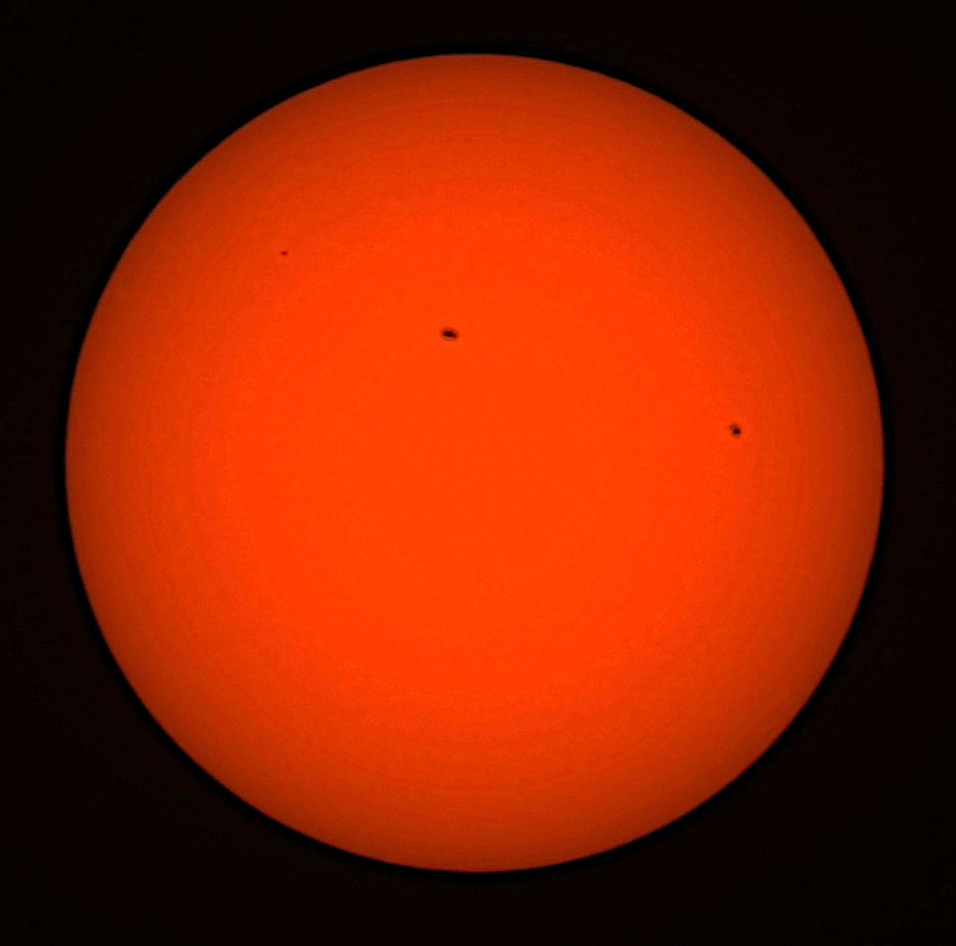
Our sun has been reverred by mankind for millenia. Stonehenge was constructed around it's properties. Around 300BC the Greek Eratosthenes correctly estimated it's distance as around 150 million km. It's yellow colour comes from the scattering of blue light by air. Before 1920 nobody understood how the sun worked. Then Cambridge astrophysicist Arthur Eddington in a talk to the British Association gave us the answer. It is a fusion reactor with hydrogen and deuterium nuclei fusing together to make helium and energy.
It is thought to have been formed around 4.6 billion years ago. In another 5 billion years hence the fusion fuel will run out, its core will increase in density and it will become a "white dwarf". On a larger scale it rotates around the centre of our milky way 250,000 light years away.
Sunspots were studied around 200BC. The sun has convective currents of coronal mass ejections flying into space, and so cooling the surface temperature. As the sun rotates with about the perion of a month so they move steadily across the sun.
The Dumbell nebula M27: Distance 1460 light years
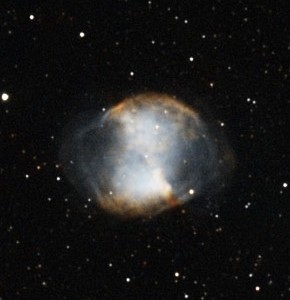
At a distance of 1460 light years, the Dumbell nebula is within our own galaxy. It was the first nebula cataloged by Charles Messier as object M27 in 1764. It is quite bright (visual magnitude 7.5) and subtends some 8 minutes, as large as Jupiter, so is easily visible with small telescopes.
A nebula is not a star but and expanding, glowing shell of ionized gas. It is thought to be centred round a red giant star late in its life. It is expected to last only for a few tens of millenia.
file:///C:/Users/colin/Documents/webgit/star/sun.jpg
The Veil nebula M27: Distance 2400 light years
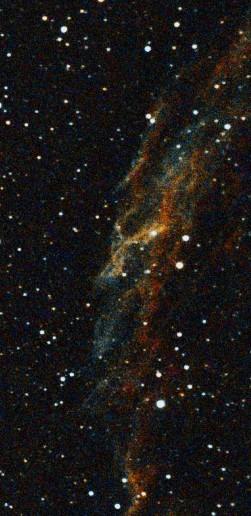
The Veil nebular has all sorts of names: Western Veil, Witch's Broom, Lacework Nebula, and even Caldwell 34. It lies in the constellation Cygnus. It is beleived to be the remnants of large star that exploded about 10,000 years ago. The gaseous remnants blown out are seen by us as "edge on", forming a "shell" covering an angular range of around 3 degrees. It is still expanding at 1.5million km/hour! The Veil nebula was discovered in 1784 by William Herschel.
The Packman nebula NGC 281: 9200 light years
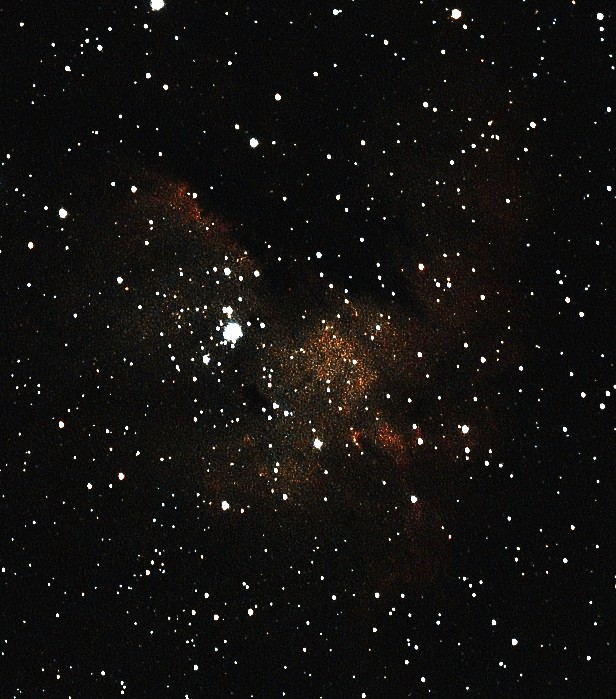
The Packman nebula is within our own galaxy's Persius spiral arm. It is a bright emission nebula and is in the constellation of Cassiopeia It was first discovered by Barnard in 1883 describing it as "a large faint nebula, very diffuse".
The Andromeda galaxy: Distance 2.5 million light years
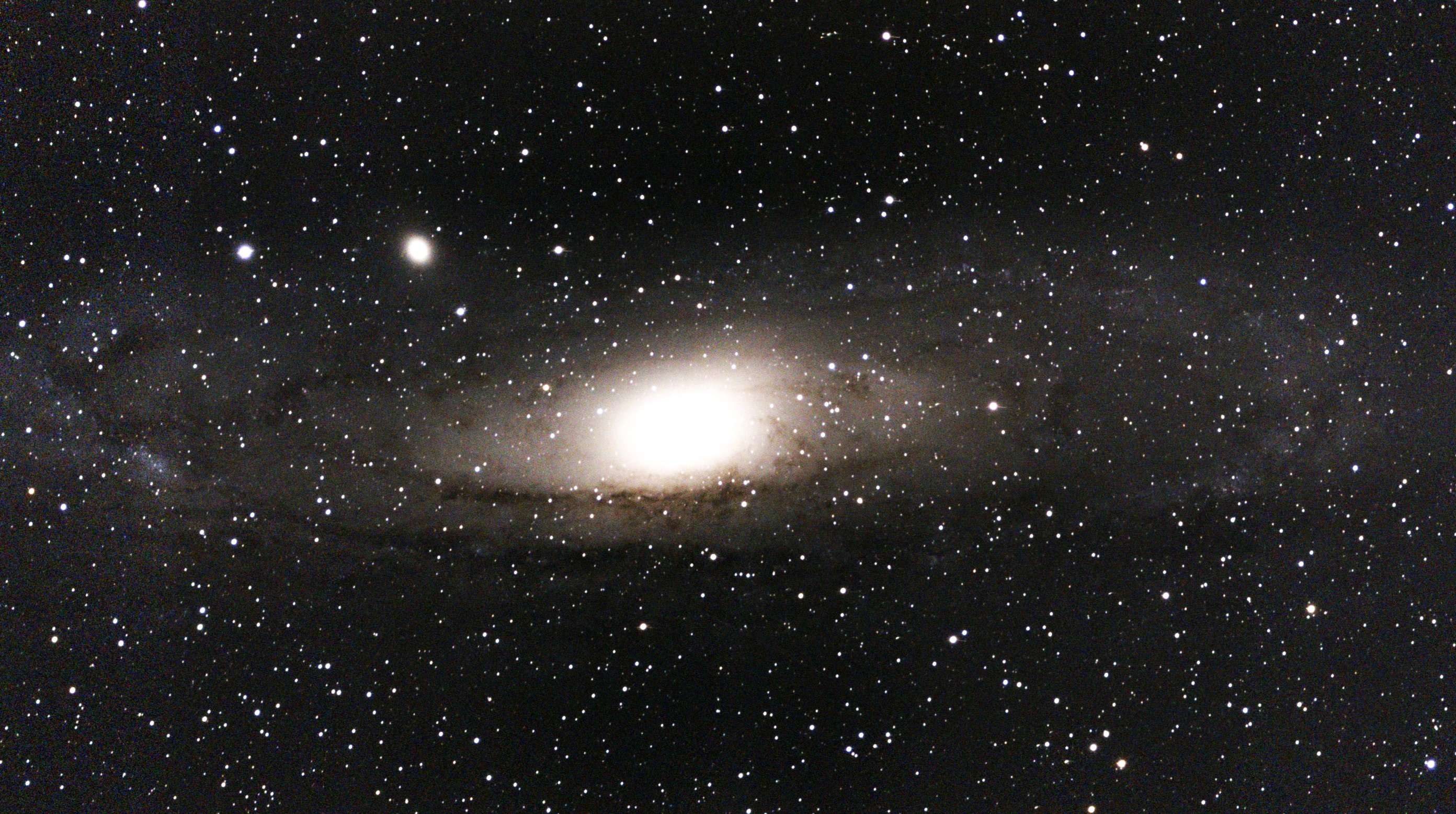
The Andromeda Galaxy is visible to the naked eye in dark skies. Around 1000BC, Persian astronomers described the Andromeda Galaxy as a "nebulous smear". Charles Messier cataloged Andromeda as object M31 in 1764. In 1864, William Huggins noted that the spectrum of Andromeda differed from that of a gaseous nebula. The spectrum of Andromeda displays dark absorption lines that help identify the chemical composition of an object. Andromeda's spectrum is very similar to the spectra of individual stars, and from this, it was deduced that Andromeda has a stellar nature. In 1912, Vesto Slipher used spectroscopy to measure the radial velocity of Andromeda with respect to the Solar System—the largest velocity yet measured, at 300 km/s (190 mi/s). It is coming towards us and may in around 7 billion years merge with our galaxy.
The Pinwheel galaxy: Distance 21 million light yea7331rs
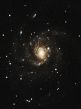
The Pinwheel galaxy M101 is a counterclockwise spiral galaxy located 21 million light-years from Earth in the constellation of Ursa Major. It was discovered by Pierre Méchain in 1781 and was communicated that year to Charles Messier, who verified its position for inclusion in the Messier Catalogue as one of its final entries.
It's spiral form is very clear. THe axis of the spiral is almost along the viewing direction.
The Whirlpool galaxy: Distance 31 million light years
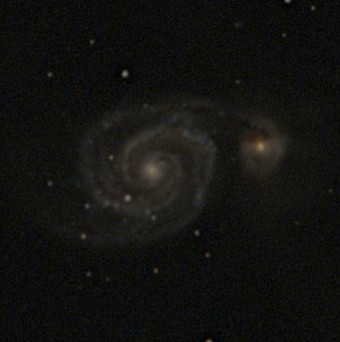
The Whirlpool galazy M31 is interesting as it has two spiral arms that both wind aroun in a clockwise direction. Its form is thought to have arisen -500 million years ago when there was a close interaction with another galaxy. Its size is around that of our galaxy but its mass is only around 1/10th.
Its central region seems to be undergoing rapid star formation. Three supernova were detected in the galaxy
The Caldwell Galaxy: Distance 44 million light years
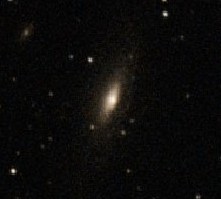
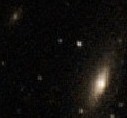
Galaxy NGC7331 is about the same size and structure as our own galaxy. It is interesting as it is thought to be an "unbarred" galaxy where the core of the galaxy rotates in the opposite direction to the spiral arms. Our photo just shows up the feint galaxy to the top left. The is NGC7335 a quite unconnected galaxy way further away at 332 million light years!
Copyright 2026 Colin Windsor : Last updated 31/1/2026