5. Coherent scattering on a pulsed source
- [62] A Constant Q Spectrometer for Pulsed Neutron Sources (1978), with Richard Heenan, Brian Boland and David Mildner.C G Windsor, P K Heenan, B C Boland and D F P Mildner, A Constant Q Spectrometer for Pulsed Neutron Sources, Nucl. Inst. and Methods 151, 477 1978.
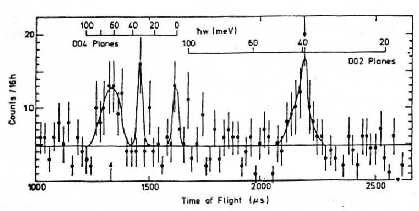
Figure 5 The first coherent phonons to be measured at constant scattering vector Q on a pulsed neutron source.
In the seventies pulsed neutron sources had a serious problem. There seemed no place for the triple axis spectrometer, and its ability to measure the coherent excitations. These phonons and magnons had been, and continued to be, neutron scattering's most important contribution to condensed matter science. Windsor's experience with both triple axis and time of flight techniques lead him to invent this new spectrometer where every channel in a time of flight scan can measure excitations at the same scattering vector Q. The prototype machine was quickly built during the hot summer of 1976, and it worked [87]. It lead to the "High Symmetry Spectrometer," first described at one of the SNS instrument discussion groups, but first built as MAX at the KEK source in Japan. Windsor was invited to Japan by the late Professor Ishikawa to help commission it [82]. It lead in turn to the ISIS PRISMA instrument, designed by Sachetti, Andreani and Windsor at the Institute for the Structure of Matter at Frascati[124]. It has proved one of the most successful of international collaborations [137].