4. Diffraction measurements to high scattering vectors -
[49] The Debye WaIler Factor of Nickel Measured at High Scattering Vectors by Pulsed Neutron Diffraction (1976), with Roger Sinclair.C G Windsor and R N Sinclair, The Debye-Waller Factor in Nickel Measured at High Scattering Vectors by Pulsed Neutron Powder Diffraction, Acta. Cryst. A32, 395, 1976.
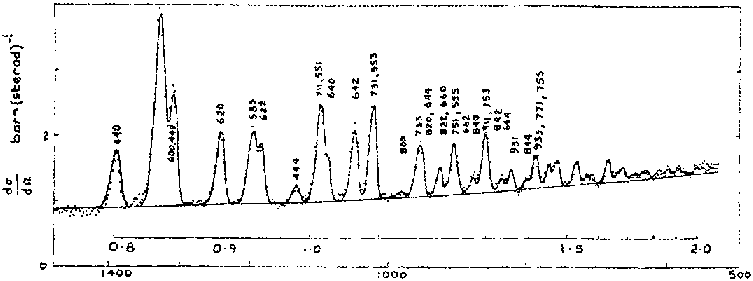
Figure 4 diffraction pattern analysed quantitatively to a scattering vector of sin
q/l = 2 A-1Windsor's experience with neutron time of flight methods on reactors lead naturally to an appreciation of the possibilities of pulsed neutron sources. He saw that their performance was quite different from that of reactors. In particular the 1/l distribution of the neutron flux coupled with the fact that the pulse width varied in proportion to l lead to a constant performance in terms of flux per resolution element. This enables useful diffraction measurements to be made over as wide as range of scattering vector as the specimen properties allow. With neutrons this fundamental limit is determined by the Debye-Waller factor - the spread in neutron positions caused by thermal motions. This experiment followed the diffraction pattern to its limit. The actual results are long forgotten, but its ideas took off. They lead directly to the back scattering spectrometers[55], and on to the ISIS HRPD which, under Bill David, was to make such an important contribution to the field of high temperature superconductivity. Its ideas were coupled with those of Jim Jorgensen from Argonne and BobVon-Dreele from Los Alamos in the classic paper [86] on profile refinement of pulsed diffraction data, defining the analysis program now installed on every pulsed neutron source.