1. Spin dynamics
-[18] Spin Correlations in a Classical Heisenberg Ferromagnet (1967)C G Windsor, Spin Correlations in a Classical Heisenberg Paramagnet, Proc. Phys. Soc. 91, 353-355, 1967.
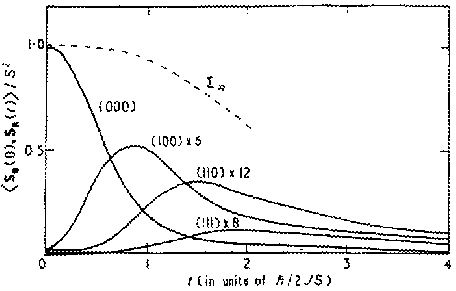
Figure 1 The first evaluation of the spin correlations in a Heisenberg paramagnet.
Colin Windsor went to Harwell following a remark by his thesis examiner Lord Marshall. He had described how inelastic neutron scattering could quickly measure the exchange interactions measured so laboriously in the thesis by electron spin resonance. His first weeks at Harwell were spent carving out a single crystal of the ideal cubic antiferromagnet RbMnO3 from a polycrystalline boule. He was rewarded by a 0.3cc crystal sufficient to measure the spin wave dispersion curve now reproduced in Kittel's "Solid State Physics"[12]. Windsor is equally happy doing theory or experiment, and most happy developing a theory to fit his experiments. In this paper he developed the spin dynamics method in order to fit his scattering data on paramagnetic RbMnO3. The spin vectors in a model lattice are followed as a function of time by integrating the equations of motion. The scattering function is obtained by Fourier transforming the correlations . He sent his program to Binder, who with others, was later to make spin dynamics into one of the most successful fields of computational physics.