
Colin Windsor
So wrote Marco Polo when he visited this city around 1280, and the Chinese are still working
hard to keep it so. The town grew large with the completion, around 700, of the Grand Canal from
Beijing, still the largest man-made waterway. It now has six million people.
I arrived at the busy bus terminal, straight from Shanghai airport,
quite lost and with only a small-scale map. I did not need to worry. Policemen were nearby.
They stood on street corners, alone and apparently with no crimes to solve. They had no guns,
no truncheons, and no cars, but they could not have been more helpful.
My first need was to find a loo, and one showed me the way, and waited for me before
directing me to the Youth Hostel. The best way was over the hill overlooking the lovely
"West Lake". I was immediately in another world of peaceful trees pagodas, sculptures,
flowers and distant views of the lake. Near the top of the hill I heard Chinese music.
They were amateurs playing in a little pagoda, their two-string violin, a flute, and a coteau.
Heaven indeed!
The Hangzhou Youth Hostel had the finest position. It was next to the Lake, and just across
from the Ferrari dealer and the Art Institute. As always in Youth Hostels, it was immediately
a home away from home with friendships easily made. There were some posh family rooms, some
overlooking the lake, but I opted for the 8-bed dorms at just £3 a night. They were mixed! My
first two nights were with 5 girls and just 2 other men. It seemed very odd the first night, but
everybody behaved with exemplary decorum. After a couple of nights it seemed completely normal
and unremarkable. It will seem quirky and unnatural to go back to male only dorms.
The hostel had the nicest food freshly cooked on the spot by the resident cook. My breakfast was soup with tiny
whole shrimps, and little suet pudding bags of tasty vedgetables.
I was here as my Florence colleague Lorenzo Capineri and I had a session on radar detection of mines
and buried objects within the big 800 strong PIERS05 electromagnetics conference. The conference
centre and hotel was another world: vast, American style, and way up-town. But I had the nicest walk along the
edge of the lake each morning. Between 7.00 and 9.00am all the Chinese come out to do their exercises.
There were perhaps 50 groups of a dozen each doing their TaiChi to a little CD player. One group
did dancing, some used swords, some played badminton. There were no joggers. At the end of the
lake I would catch a bus. They cost about 10p and were frequent and efficient. Most people clearly
had a season ticket. They would wave their handbag in front of black box, which would give a beep.
Our hostel rooms had the same high-tech entry system.
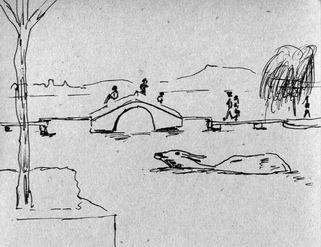
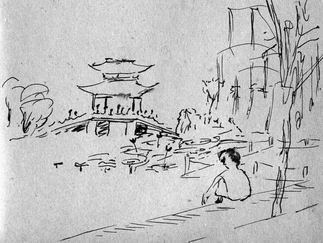
The lake was easy and pleasant to walk round in a day. Although artificial it had existed
for 1500 years. The picture shows the famous "Scholar's Bridge" near the youth hostel with the
great brass buffalo half submerged in the water. The bridge was all of granite and build to
last for ever. The walks and gardens were looked after by an army of ladies, of all ages, with
bamboo brushes and a pan. They would pick up every leaf! The walks and trees were all floodlit,
and even late at night were full of happy people, taking the air and enjoying the beauty.
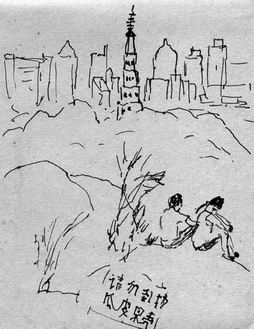
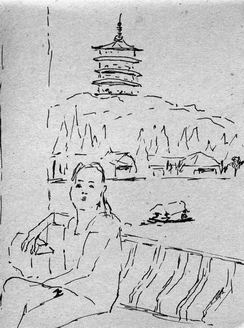
To the south of the lake, the picture shows Xizhao (Sunset Hill) with the newly restored Leifeng
Pagoda. Although originally for storing Buddist sacred scrolls, it is now a tourist location.
Escalators take you to the top of the hill and a lift takes you to the top of the pagoda!
The view takes in the whole city, the whole lake and all the surrounding hills which rise
quite steeply from the plane of the city. All around the inside the top story is a giant
painting of view from the pagoda made in ancient times. All the time I was there, the weather was not clear,
but a soft, misty light that made the lines of hills recede back into space.
The lake contains two causeways of ancient origin, which stretch across its western and
northern shores like a giant promenade. The Western Su causeway dates from 1090, when the
lake was dredged and the causeway created from the material.
Today they are full of walkers and cyclists enjoying the
every changing views of the islands. At the Northern end of the west causeway are the most
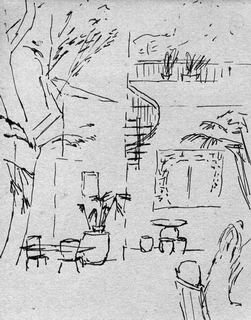
beautiful gardens I saw. They belonged to Quyuan Park (Crooked Courtyard) an old winery dating
back to the Song Dynasty 1000 years ago. The water gardens were immaculate, full of lotus
flowers and sculptures. While I was there one of its old buildings was being used as a film
set for a school class room of ancient China. I watched as the children, all dressed in
traditional smocks, threw their books into the air at some celebration.
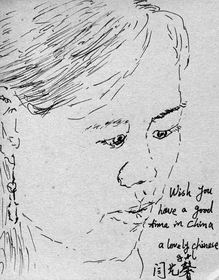
It was an unexpected delight in China that strangers will talk to you. Going back to Shanghai
by train a girl spoke to me while we waited on the platform. She turned out to be good at
English, indeed a teacher, and charming to talk to. We shared our meagre food and drink in the
very crowded carriage, and the two-hour journey passed in a flash. I felt I had made a true
friend by the time we arrived at Shanghai.
But where is God among all this beauty and kindness? The young Chinese were surprisingly open.
Religion is now tolerated, but not in the Communist Party, which you still have to join
if you want to get on. The pagodas might have Buddhist origins but they are now for tourists
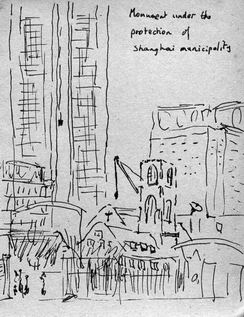
not worshippers. The lower picture shows the People's Square in Shanghai where I arrived
on my way home. The church is "A monument under the protection of Shanghai municipality."
It was rather tastefully converted into offices in the shadows of the great new skyscrapers.
They have swept God off the streets, along with the leaves, but not from the people's souls.
Copyright 2005 Colin Windsor : Last updated 5/9/2005